

[ Projects ]
Pearl Hyde Community Primary School | Coventry
Project Background
Pearl Hyde Community Primary School in Coventry was looking to modernise its ageing electric heating system with a solution that would improve energy efficiency, reduce running costs and create a safer, more practical learning environment for both pupils and staff.
Like many schools built during the same period, the classrooms and corridors were heated by large electric storage heaters positioned around the perimeter of each room. These bulky units occupied valuable floor and wall space, limiting classroom layouts and reducing the available area for educational displays, storage and teaching resources.
Due to the high surface temperatures of the storage heaters, protective radiator guards had been installed throughout the school to prevent accidental contact. Although essential from a safety perspective, these guards significantly restricted heat output, reducing heating performance by as much as 40%. This meant the heaters had to operate for longer periods in an attempt to maintain comfortable temperatures, resulting in high electricity consumption and increasing the school's heating costs.
The storage heaters also projected into classrooms and corridors, creating unnecessary obstacles and reducing the usable teaching space available. Their slow response times meant they were unable to react efficiently to changing occupancy patterns or varying weather conditions, often leading to classrooms being heated when they were unoccupied or requiring lengthy pre-heating periods before pupils and staff arrived.
Pearl Hyde Primary School wanted a modern heating solution that would maximise available classroom space, improve comfort, provide intelligent control of heating throughout the building and significantly reduce energy consumption. As part of the school's wider sustainability strategy, a new solar PV system was also planned, making the transition to an efficient all-electric infrared heating system an ideal long-term solution.
Infrared Group was appointed to design and install a bespoke heating system that would overcome the limitations of the existing installation while delivering intelligent room-by-room control, lower operating costs, improved safety and a future-proof heating solution that will integrate seamlessly with the school's renewable energy generation.




Objectives:
Reduce energy consumption and operating costs by replacing inefficient electric storage heaters with a modern infrared heating system and intelligent heating controls.
Improve heating comfort and responsiveness by providing targeted, room-by-room heating that can be programmed around classroom occupancy and school operating hours.
Maximise usable classroom space by removing bulky storage heaters, eliminating trip hazards and freeing up valuable floor and wall space for teaching resources and displays.
Enhance safety throughout the school by removing the need for hot, floor-mounted storage heaters and bulky radiator guards, replacing them with ceiling-mounted infrared panels safely positioned out of reach.
Provide intelligent centralised heating management through the SALUS Smart Control System, allowing different user access levels, remote monitoring, occupancy scheduling and temperature limits to prevent unnecessary energy use.
Support the school's long-term sustainability goals by delivering a future-proof, all-electric heating solution that integrates seamlessly with the planned solar PV installation, helping to reduce carbon emissions and long-term energy costs.
Key Features:
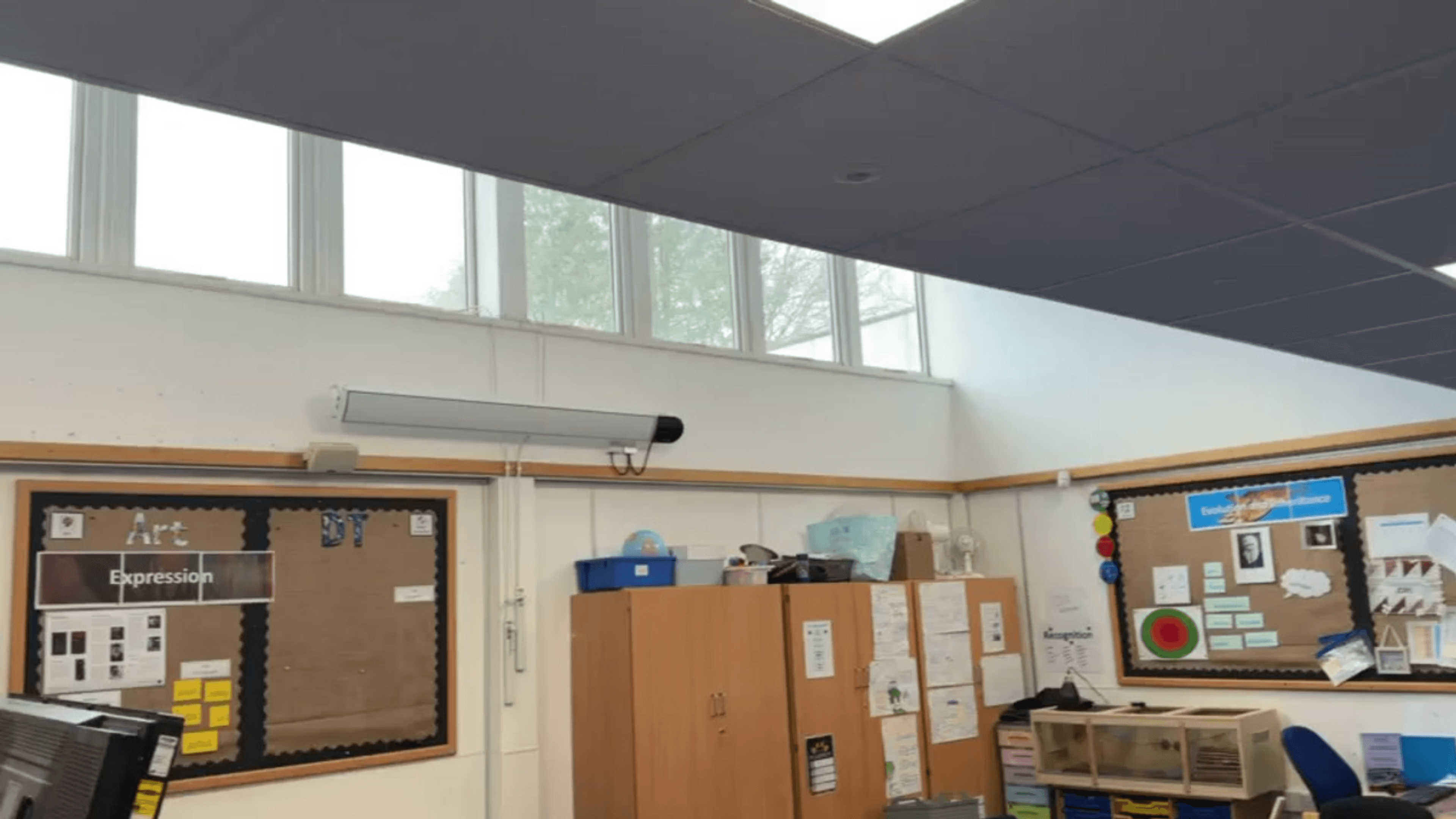
79 ceiling-mounted infrared heating panels installed throughout the school, using a combination of 450W and 900W slimline panels integrated into the suspended ceiling.
12 high-performance infrared bar heaters installed in larger open areas to provide targeted radiant heat in high-ceiling spaces.
SALUS Smart Control System providing individual room scheduling, centralised control, remote access, user permissions and temperature limits.
Wall-mounted smart thermostats in classrooms, giving teachers local control within pre-set limits to prevent overheating and unnecessary energy use.
Full circuit zoning plan provided, clearly detailing which panels and heaters are connected to each circuit for safe operation, straightforward maintenance and future system management.
Discover Phase
Conducted a comprehensive site survey to assess the existing heating system, building layout and classroom requirements.
Calculated room-by-room heat losses and identified the most suitable infrared heating solution for each space.
Worked closely with the school to understand occupancy patterns, operational requirements and long-term sustainability objectives.
Design & Development Phase
Produced a bespoke heating specification incorporating 79 ceiling-mounted infrared panels and 12 infrared bar heaters.
Designed a fully zoned SALUS Smart Control System with individual classroom scheduling and centralised building management.
Developed detailed electrical layouts, circuit zoning plans and installation drawings to ensure a smooth delivery.
Planned the installation to minimise disruption to teaching and coordinate with the school's wider refurbishment and solar PV project.
Implementation Phase
Removed the existing electric storage heaters and installed the new infrared heating system throughout the school.
Installed and commissioned the SALUS Smart Control System, including thermostats, scheduling and user access permissions.
Completed electrical testing, commissioning and system optimisation to ensure safe and efficient operation.
Delivered staff training, handover documentation, certification and ongoing technical support following project completion.

Results
Significantly improved energy efficiency through intelligent room-by-room heating control and targeted infrared heating technology.
Reduced running costs by eliminating unnecessary heating of unoccupied classrooms and integrating with the school's planned solar PV system.
Increased usable classroom space by removing bulky storage heaters and freeing up valuable floor and wall areas for teaching resources.
Enhanced safety and comfort by replacing hot, floor-mounted heaters with ceiling-mounted infrared panels safely positioned out of reach.
Future-proofed the school's heating infrastructure with a low-maintenance, fully electric, smart-controlled system designed to support long-term sustainability and decarbonisation goals.
Minimised ongoing maintenance requirements with infrared panels designed to last over 40 years, reducing maintenance costs, equipment failures and day-to-day management for the school's facilities team.